

Jenna’s story: Slow transit constipation
30 January, 2026
By Jenna Robinson
What is Slow transit constipation?
The large intestine massages waste along its length to the rectum by rhythmic, muscular contractions of its walls (peristalsis). This activity is controlled by nerves of the enteric nervous system (ENS). Slow transit constipation (STC), formerly known as neuronal intestinal dysplasia (NID), is characterised by the reduced motility (spontaneous movement) within the large intestine, caused by abnormalities of the enteric nerves.
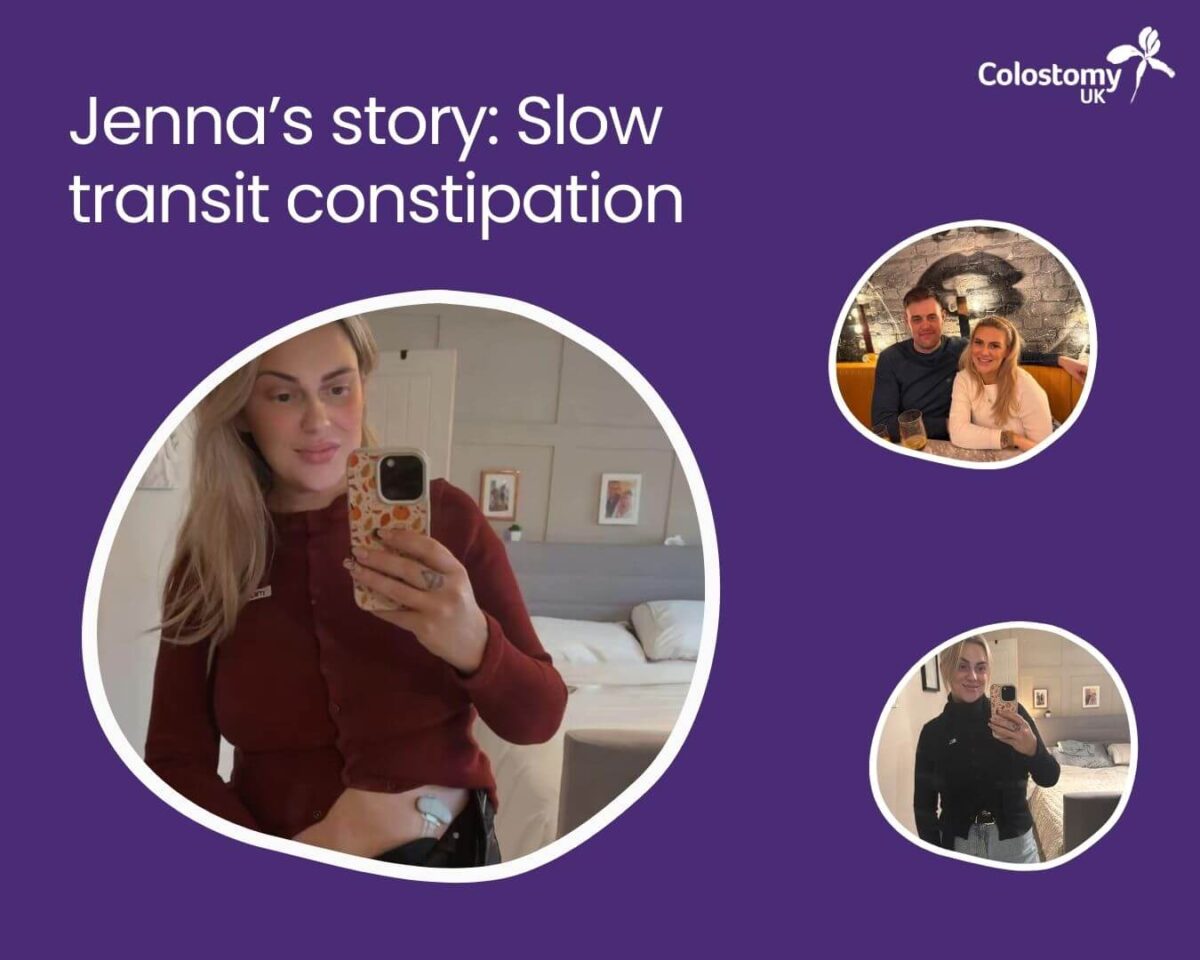
Slow transit constipation is a condition that many people have never heard of – yet for those living with it, the impact can be life-changing. Jenna, 38, shares her experience of living with slow transit constipation and how surgery helped her regain her quality of life.
Living with slow transit constipation
“I’ve been suffering with slow transit constipation for around eight years now,” Jenna explains. “I tried laxatives and anal irrigation, which I was told I would need to do three times a week for the rest of my life. Being told that was really distressing – it’s such an invasive treatment.”
Slow transit constipation occurs when stool moves very slowly through the bowel, making it difficult or impossible to pass stools normally. For some people, it can lead to severe constipation, pain, bloating and complications such as fissures and piles.
Jenna also lives with functional neurological disorder (FND), diagnosed in 2019, as well as fibromyalgia. “My neurological consultant explained that slow transit constipation could be another umbrella symptom of FND. Having both diagnoses together made everything worse – I have a lot of body pain, and passing stools became incredibly difficult.”
At its worst, Jenna would not open her bowels for at least nine days at a time. “I was chronically constipated and desperately looking for someone with a story like mine – something to give me hope that there were other treatment options.”
Years of tests and treatments
Over the years, Jenna tried multiple treatments. She had anal Botox injections several times to help relax the muscles and underwent examinations under general anaesthetic. She was diagnosed with chronic fissures and piles, which caused daily pain and bleeding.
“I had every test you can think of. I was tested for Crohn’s and colitis, but everything always came back clear. That was incredibly frustrating – I needed answers, and it felt like nobody could give me them.”
Jenna believes her symptoms began after the birth of her daughter eight years ago. “I had a caesarean section and one of the side effects can be constipation. I hadn’t been to the toilet for eight days and was advised to try a suppository. Ever since then, I’ve never been the same.”
The condition began to affect every aspect of her life. “I had to plan journeys around toilets. I was in constant pain and bloated all the time. Once, we went to the seaside with my children but had to turn straight back because the pain was unbearable.”
Over time, the physical symptoms took a toll on Jenna’s mental health. “I would have panic attacks before going to the toilet because I knew how painful it would be. I’d bleed heavily and pass blood clots. It felt like trying to put a triangle through a circle – it just doesn’t work.”
A life-changing decision
Eventually, after years of searching for answers, Jenna underwent surgery to form a loop ileostomy.
“After the surgery, it was like somebody waved a magic wand. All my pain and discomfort slowly disappeared. Having an ileostomy comes with its own challenges, but I would choose these challenges over what I was dealing with before, every single time.”
Although the ileostomy could be reversed, Jenna doesn’t see that happening. “My quality of life is so much better now.”
Looking back, Jenna feels strongly about the importance of being heard. “I changed consultants from a male to a female, who I felt was more compassionate and really understood my symptoms. She referred me to dietitians and pelvic floor physiotherapy, although unfortunately that didn’t help me. But she was the one who ultimately saved my life.”
Raising awareness and offering hope
“I struggled to find people like me,” Jenna says. “I needed hope and reassurance not to give up.”
Now, she is determined to raise awareness of slow transit constipation. “I want people to know there are other options, and that it’s okay to keep asking questions and pushing to be listened to. I waited eight years for the right treatment – I hope others don’t have to wait as long as I did.”
At Colostomy UK, we believe sharing real experiences like Jenna’s helps others feel less alone. Slow transit constipation can be debilitating, but support, understanding and the right treatment can make a real difference.
If you’re struggling with bowel symptoms that are affecting your quality of life, you are not alone – and help is available.
Read Jenna’s story in the sun: thesun.co.uk
For more support and advice please contact us on: 0800 328 4257 or visit our support page for more ways to get in touch: colostomyuk.org/support