

A Day in the Life of a Urostomate
13 August, 2026

By Merv Quick
September is Urology Awareness Month. To mark the occasion, urostomate Merv Quick talks us through his typical day.
Every person living with a urostomy is different, as are their needs, preferences and routines. This article is an account of Merv’s personal experiences only.
Morning: The Bag Change (…on Alternate Days)
Let me walk you through my typical day living with a urostomy, complete with a minor 9am wobble and a mid-afternoon pint.
The good news? Nine years on from my surgery, “a typical day” really is just that: ordinary, full, and manageable.
Every other day begins with what most urostomates call their morning ritual: the pouch change.
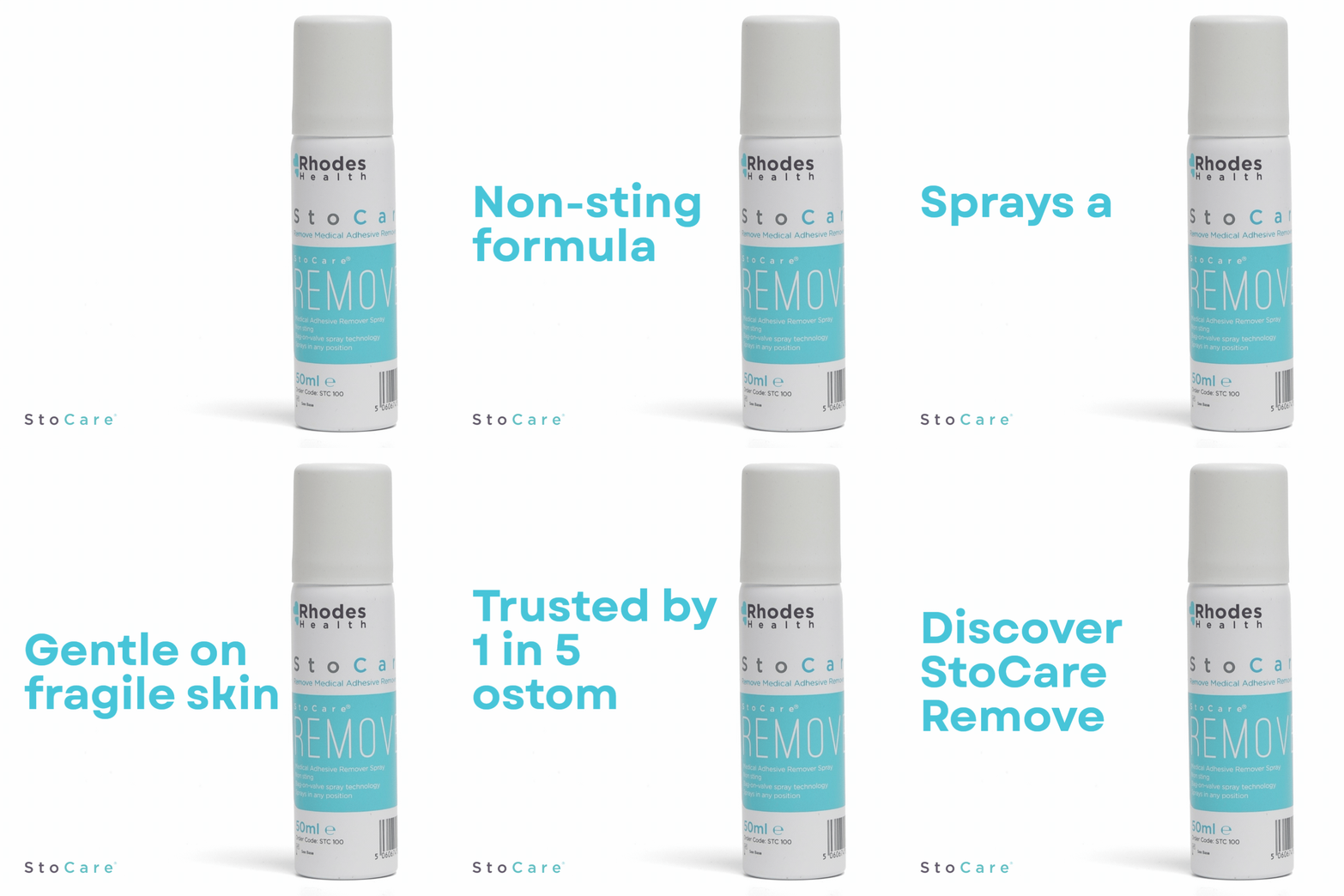
Before I do anything else, I lay out all my supplies in a row: new pouch, adhesive remover spray, and disposal bags.
The golden rule: set out your stall before you begin. Running out of adhesive remover halfway through is a special kind of chaos you only need to experience once.
The change itself takes about five minutes.
A word of warning, though – your stoma has absolutely no bladder control and will decide to “go for a wee” whenever it pleases. So changing your bag in a carpeted room is a bold choice! Using a bathroom is the safer option.
Once the fresh pouch is on, I press the palm of my warm hand firmly over the adhesive wafer for a couple of minutes. Body heat activates the bond, and those two minutes of patience save hours of grief later.
While I’m at it, I prep several new pouches in one go, putting the safety bung into the drain tap of each pouch. I learnt the hard way what happens when you apply a perfect bag and then realise the tap is still wide open!
Through the Day: Emptying and Getting On With It
On a normal day, I empty my pouch perhaps twice; once mid-morning, once mid-afternoon.
That’s roughly the same frequency I used the bathroom before my surgery. (This is not the same for everyone. Some people need to empty their pouches much more frequently).
If the afternoon involves a couple of pints of brown ale, I’ll be emptying it rather more enthusiastically.
The key point is that you plan around it the same way you always planned around needing the loo.
Out and about, I carry three things:
- An Emergency ‘No Waiting’ Card or an ID card, which explains to businesses that I need urgent priority access to their toilet.
- A Radar Key, which unlocks disabled public toilets across the UK.
- A small ‘go-bag’ with a full change of supplies.
The go-bag helps relieve any anxiety of having a potential leak when out of the house.
When the Day Involves Travel
If I know I have a big travel day ahead (a long train journey, or a flight, for example), I put on a fresh pouch that morning regardless of whether it is technically due to be changed, as this is one less variable to worry about.
On aeroplanes I also keep a few large-capacity pouches handy, because when you are strapped into seat 23B with the seatbelt sign on, a standard-sized bag runs out of room faster than you might hope.
Some airlines also offer increased hand luggage for ostomates through assisted travel services, so it’s worth checking ahead of travel.
Some airports also issue special lanyards to alert security that you may need additional support.
I have travelled to India and back without a single incident, which ought to reassure anyone worried about whether a urostomy means the end of adventure.
The rule I follow is simple: take three times the supplies you think you need, and split between your hand luggage and checked bags. Then, if you lose one bag, you still have everything you need in the other.
A travel certificate signed by your GP (available from Colostomy UK in multiple languages) is also worth carrying for airport security, though in nine years I have never actually needed to produce it.
Evening: The Night Bag
Before bed, I connect my pouch to a larger night drainage bag, which sits on the floor beside the bed.
Some nurses recommend strapping the drainage tube to your leg, but I find that restricts how freely I can roll over in the night.
My solution is a pair of boxer shorts with the tube threaded through the fly opening.
It sounds inelegant, and it is, but it gives enough slack to roll left, right, or flat on your back without a second thought.
You don’t have to use a night bag at all, of course – you can simply wake up to empty as needed.
But for sleeping through undisturbed, the night bag is worth its weight in gold.
What to Do When Leaks Happen (As They Will, Occasionally)
Even now, I get one or two leaks a year.
Invariably it is user error; I rushed the application of the pouch, or I got absorbed in something and forgot to empty the bag until it was considerably past full.
In the early months after surgery, leaks are more common simply because your body is still settling into its new shape.
A pouch that fitted perfectly in week two may not sit correctly in week six.
If that happens, contact your stoma nurse. They will likely recommend a different pouch shape (a convex wafer, for example) that will solve the problem.
Don’t struggle alone; your stoma nursing team exist precisely for this reason.
I would also recommend a waterproof mattress protector as leaks may still happen from time to time.
A Note on Supplies
Your monthly supplies – pouches, night bags, adhesive remover, wipes, disposal bags, etc. – are delivered on prescription.
One thing worth knowing: you are not tied to a single supplier.
If the service is poor or a product gets discontinued (as happened to me), you can switch within days.
Online communities like the Colostomy UK Facebook group are invaluable for recommendations.
Just remember to let your GP know when you change.
The Honest Summary
A urostomy is a significant change.
I won’t pretend the first few months are entirely carefree – there is a learning curve, and the occasional moment where things do not go to plan.
But the rhythm comes quickly.
Within a few months, the morning bag change is as unremarkable as making coffee.
The travel anxiety fades.
The social confidence returns.
Life with a urostomy is not a lesser version of life.
It is just life with a slightly more eventful routine.
Have a Question for Merv?
Merv is happy to answer your questions.
Please email editor@colostomyuk.co.uk to get in touch.
Support From Colostomy UK
We offer a wide range of support for people living with a stoma, including our free Stoma Helpline, live chat support, and opportunities to connect with others through local and online groups. We also provide trusted information and resources to offer practical advice, reassurance, and the confidence to live well with a stoma: colostomyuk.org/support